
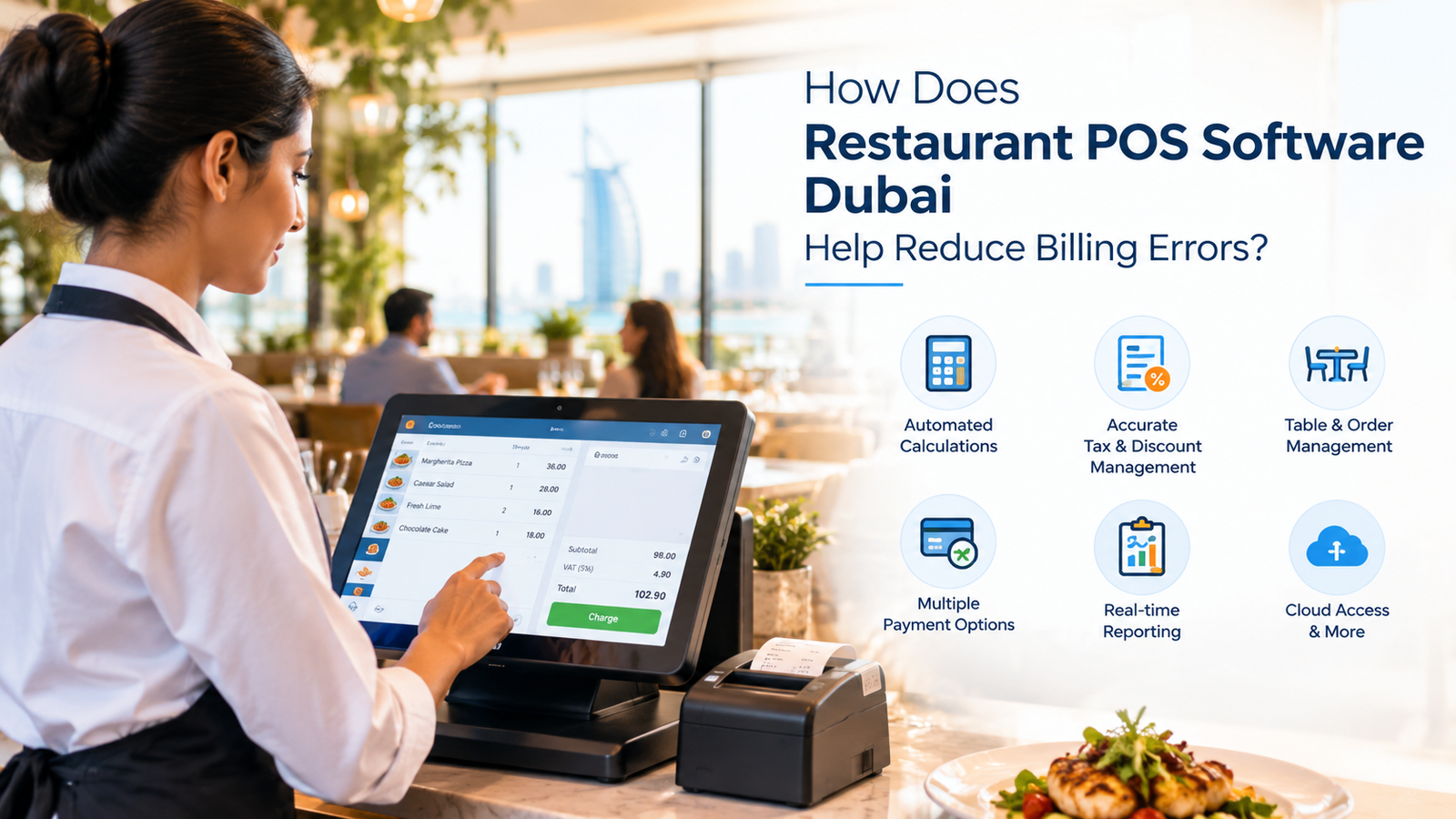
How Does Restaurant POS Software Dubai Help Reduce Billing Errors?
Billing is one of the most important parts of restaurant operations. A small mistake in an order, discount, tax calculation, payment entry, or final invoice can create confusion for customers and additional work for staff. When a restaurant handles dozens or hundreds of transactions each day, relying entirely on manual billing can make these errors more difficult to control.
This is where restaurant POS software Dubai can make a practical difference. A modern point-of-sale system connects order taking, billing, payments, table management, inventory, and reporting in one system. By reducing repetitive manual entries and automating calculations, POS software can help restaurants improve billing accuracy and maintain more consistent transaction records.
For restaurants looking for POS system software for restaurant Dubai, understanding how these systems reduce billing mistakes can help when evaluating different solutions.
What Causes Billing Errors in Restaurants?
Before understanding how POS software helps, it is useful to identify common reasons billing mistakes occur.
Restaurants may experience billing problems because of:
- Incorrect item quantities
- Manually entered prices
- Missed or duplicated items
- Incorrect discounts
- Wrong tax calculations
- Miscommunication between servers and kitchen staff
- Incorrect table numbers
- Mistakes while splitting bills
- Cash or card payment entry errors
- Manually prepared invoices
- Incorrect cancellation or modification of orders
During busy periods, staff have to manage customers, orders, tables, payments, and kitchen communication simultaneously. A digital restaurant POS system can organize many of these processes and reduce the amount of information that employees need to enter manually.
1. Automated Billing Reduces Manual Calculation
One of the biggest advantages of restaurant POS software is automated billing.
Instead of manually calculating item prices, quantities, discounts, and applicable taxes, the system can generate the bill based on the information entered into the POS. This reduces the need for staff to perform calculations separately.
MargBook’s restaurant POS solution highlights fast billing and automated invoice generation, including support for VAT-compliant invoices.
For example, when a server selects two main courses, one beverage, and a dessert from the POS menu, the system can calculate the total according to the configured prices. This helps reduce arithmetic mistakes and makes the billing process more consistent.
2. Accurate Menu Pricing Helps Prevent Incorrect Bills
Another common billing problem occurs when staff manually enter prices.
Restaurant POS software allows businesses to maintain menu items and their prices within the system. When employees select an item, the configured price can be applied automatically rather than requiring the employee to type it every time.
This can be particularly useful for restaurants with:
- Large menus
- Multiple categories
- Different portion sizes
- Combo meals
- Regular menu changes
- Multiple branches
Keeping pricing information centralized can make it easier for restaurant managers to maintain consistent billing across transactions.
3. Discounts Can Be Managed More Consistently
Discount-related mistakes are another potential source of billing disputes.
For example, an employee might accidentally apply the wrong percentage, forget to apply an approved offer, or calculate a discount incorrectly. A POS system can help businesses configure discount rules and apply them through the billing process.
MargBook’s POS software includes discount and scheme management capabilities, allowing businesses to manage different discount types and review related reports.
This creates a more structured process for applying promotions instead of depending entirely on manual calculations.
4. VAT Calculation Can Be Automated
For restaurants operating in the UAE, tax calculation is an important part of invoicing.
Manual tax calculations can create unnecessary opportunities for mistakes, particularly when employees are processing a large number of bills. Restaurant POS software designed for the UAE can help automate applicable VAT calculations and generate appropriate invoice information.
MargBook’s restaurant POS page states that its solution supports UAE VAT-related billing, including automated 5% VAT calculation and invoice details such as TRN and tax breakdowns. Businesses should still verify their configuration and compliance requirements with an appropriate tax professional or the relevant UAE authorities.
Automating calculations can make the billing workflow more consistent and reduce the possibility of employees calculating tax separately for each transaction.
5. Direct Order-to-Bill Flow Reduces Data Entry
A restaurant POS system can connect order taking with billing.
When an employee enters an order into the POS, the same order information can be used when preparing the customer’s final bill. This reduces the need to rewrite the order manually at the billing counter.
The fewer times information has to be re-entered, the fewer opportunities there are for:
- Missing items
- Duplicate items
- Incorrect quantities
- Wrong prices
- Misread handwritten notes
This is especially useful during busy restaurant hours when employees need to process orders quickly.
6. KOT and Kitchen Integration Can Reduce Order-Related Mistakes
Billing accuracy does not depend only on the billing counter. The original order must also be recorded correctly.
MargBook’s restaurant POS system describes KOT and Kitchen Display System integration, where orders can be sent directly to the kitchen and modifications can be displayed for preparation.
This can help create a clearer connection between the customer’s order, the kitchen, and the final bill.
For example, if a customer changes an order or requests a modification, recording that information digitally can help reduce the risk of relying on verbal communication or handwritten notes.
7. Table Management Helps Keep Orders Organized
For dine-in restaurants, another possible source of confusion is associating orders with the correct table.
A restaurant POS with table management can help staff organize orders according to table numbers and table status. This can be useful when several tables are being served simultaneously.
MargBook highlights table management capabilities such as assigning, merging, and splitting tables.
Better table organization can help reduce situations where an order is accidentally associated with the wrong table or included in an incorrect bill.
8. Split Bills Become Easier to Manage
Customers often request separate bills when dining in groups.
Manually dividing a bill can result in calculation mistakes, especially when customers share dishes, apply discounts, or use different payment methods.
A restaurant POS can simplify this process by allowing staff to manage bill splitting through the system. MargBook specifically highlights split-bill functionality within its restaurant POS billing features.
This can make group billing more organized while reducing the need for manual calculations.
9. Multiple Payment Methods Can Be Recorded More Clearly
Modern restaurants may accept cash, cards, mobile wallets, QR payments, and other payment methods.
When payment information is recorded manually, reconciliation can become more difficult. POS software can provide a centralized transaction record and help staff associate payments with individual bills.
MargBook’s restaurant POS solution supports multiple payment methods and provides transaction and reporting capabilities.
This can help restaurant managers compare sales records with payment records and identify discrepancies more efficiently.
10. Inventory and Billing Data Can Work Together
Billing accuracy is also connected to inventory accuracy.
When sales are recorded through a POS system, inventory information can be updated based on transactions, depending on the system’s configuration. MargBook describes real-time inventory tracking and stock updates as part of its POS capabilities.
This gives restaurant managers a more connected view of sales and stock instead of maintaining completely separate records.
For example, if a menu item is sold repeatedly, the corresponding inventory information can be reflected in the system. This can help businesses monitor stock levels and investigate unusual discrepancies.
11. Reports Help Managers Identify Billing Discrepancies
Reducing errors is not only about preventing mistakes. Restaurants also need to identify problems when they occur.
POS reporting can provide information about sales, transactions, discounts, inventory, and other operational activities. Managers can use these records to review unusual transactions and investigate discrepancies.
A centralized reporting system can make it easier to answer questions such as:
- Which transactions were cancelled?
- Which discounts were applied?
- What were the day’s total sales?
- Which payment methods were used?
- Are there differences between expected and recorded payments?
- Which menu items generated the most sales?
Having organized records makes restaurant management more transparent and can support better operational decisions.
12. Cloud-Based POS Gives Managers Better Visibility
For restaurant owners managing more than one outlet, billing accuracy can become even more important.
A cloud-based POS system can provide centralized access to sales and operational information, depending on the system and configuration. MargBook describes cloud-based access and centralized management capabilities for businesses operating across multiple locations.
Instead of relying on separate manual spreadsheets from each branch, management can work with information maintained within a centralized system.
Why Choose the Right POS System for a Dubai Restaurant?
Not every POS system provides the same functionality. Restaurant owners should evaluate software according to their actual operational requirements.
Important features to consider include:
- Automated restaurant billing
- Menu and pricing management
- VAT-related billing capabilities
- Table management
- Split billing
- KOT or kitchen integration
- Inventory management
- Multiple payment options
- Sales reporting
- Multi-outlet management
- Cloud access
- Data security and backups
- Ease of use for restaurant employees
A system should not simply add technology to the restaurant. It should make everyday processes easier to manage and reduce unnecessary manual work.
How MargBook Can Help Restaurants Manage Billing
MargBook provides restaurant POS functionality designed to bring several restaurant operations into one system. Its restaurant solution includes billing, table management, KOT/KDS integration, inventory tracking, VAT-related invoicing, payment options, reporting, and cloud-based access.
For a Dubai restaurant, these features can help create a more structured workflow from order entry to final payment.
Restaurants can explore the MargBook Restaurant POS System to understand the available features and determine whether they match their operational requirements.
Final Thoughts
Billing errors can affect customer experience, staff productivity, financial records, and restaurant operations. While no software can replace proper staff training and effective processes, the right restaurant POS software Dubai can reduce many errors associated with manual data entry and calculations.
Automated billing, centralized menu pricing, discount management, VAT calculations, table management, order-to-kitchen workflows, split billing, payment recording, inventory tracking, and reporting can create a more organized billing process.
For restaurants searching for POS system software for restaurant Dubai, the key is to choose a solution that fits the restaurant’s size, workflow, payment requirements, menu structure, and management needs. A well-configured POS system can help restaurants move from fragmented manual processes toward a more consistent and trackable billing operation.
Frequently Asked Questions
- How does restaurant POS software reduce billing errors?
Restaurant POS software reduces billing errors by automating calculations, using stored menu prices, managing discounts, recording orders digitally, and generating bills from transaction data. - Can restaurant POS software calculate VAT automatically?
Some UAE-focused POS systems can automate VAT calculations and generate tax-related invoice information. Restaurant owners should ensure the system is configured correctly for their applicable requirements. - Can a POS system help with split restaurant bills?
Yes. Restaurant POS systems may provide split-bill functionality, allowing staff to divide a customer’s bill more efficiently than performing calculations manually. - Does POS software help reduce order mistakes?
It can. Digital order entry and KOT/KDS integration can reduce errors caused by handwritten orders or verbal communication between restaurant staff and the kitchen. - What should restaurants check before choosing POS software in Dubai?
Restaurants should consider billing, VAT-related features, table management, order handling, inventory, payment methods, reporting, integrations, cloud access, security, and ease of use.